Table of Contents
- 1. Why This Feature? The Double-Data Problem of Traditional SSR
- 2. Anatomy of the Wire: Deconstructing Flight Chunks
- 3. The Forensic Hazard: Payload Bloat and ORM Model Leakage
- 4. Flight Protocol vs. Alternative Framework Wire Formats
- 5. Python Reference: Parsing the Flight Protocol
- 6. Systems Architectural Summary
- References & Further Reading
Open the Network tab in your browser while inspecting a modern Next.js App Router application during a client-side route transition.
Filter by Fetch/XHR. Click on a navigation link. You will not see a traditional JSON payload like you would from a REST API or tRPC. Nor will you see raw server-rendered HTML like you would from WordPress, Rails, or PHP.
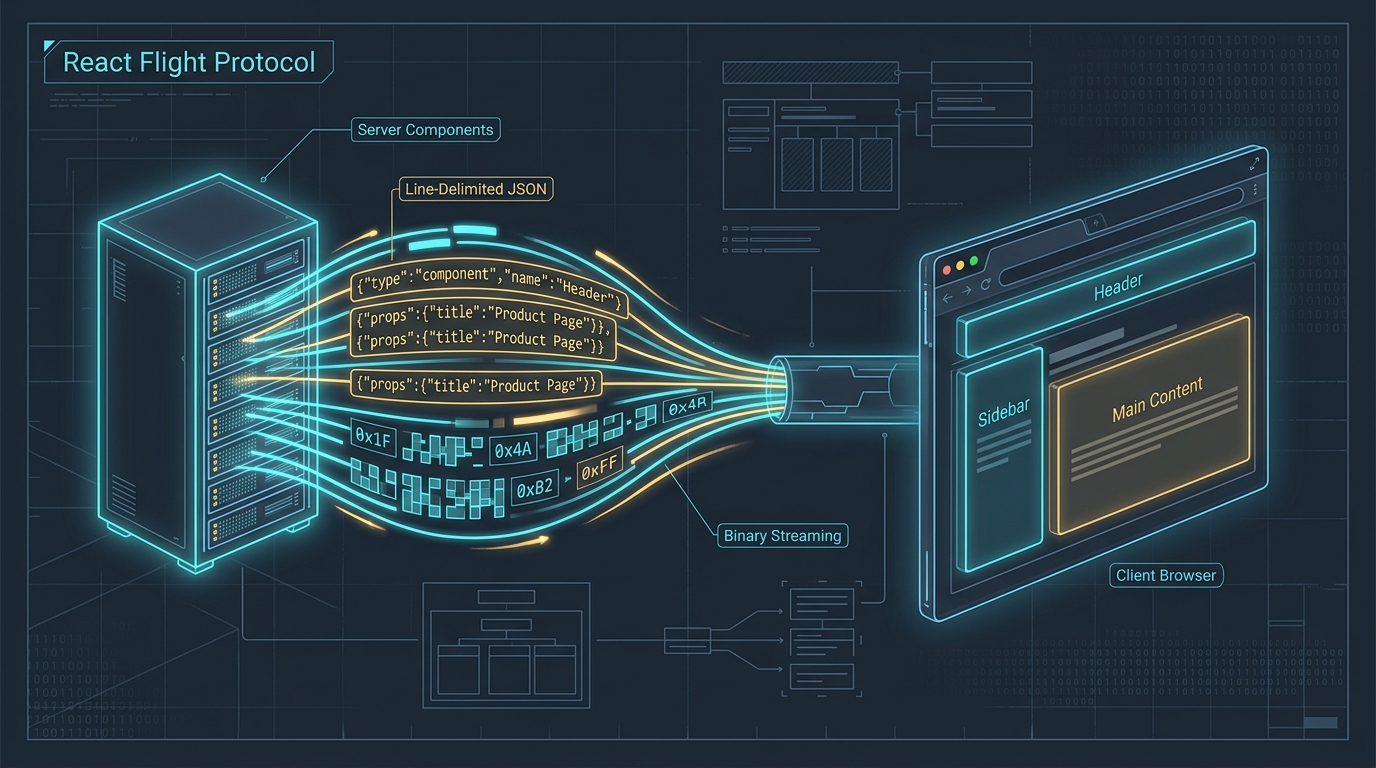
Instead, you will see a strange, streaming response with the header Content-Type: text/x-component. The payload arrives in numbered, line-delimited text chunks that look like an alien serialization format:
1:I["(app-pages-browser)/./src/components/badge.tsx",["app/layout","static/chunks/app/layout.js"],"Badge"]
0:{"name":"Modern Architecture","badge":"$1"}
2:D{"defer":true}
3:H["layout.css"]
This is the React Flight protocol—the wire format that powers React Server Components (RSC) [1] [2].
Despite being the most consequential architectural shift in React's twelve-year history, the Flight protocol is rarely discussed at the byte level. Keynotes and documentation speak of Server Components as an abstract mental model: "components that run on the server and never ship to the client."
But in production systems engineering, abstractions are leaks waiting to spring. When does the Flight protocol outperform JSON? When does it secretly bloat your wire payload by 400%? And what happens when an engineer accidentally serializes an entire database ORM model across the server-client boundary?
Here is the complete wire-level breakdown of the React Flight protocol.
Figure 1: The React Server Component serialization pipeline and Flight streaming lifecycle across network boundaries. Modules with 'use client' are emitted as manifest references (1:I), while pure server components are lowered to line-delimited Virtual DOM descriptors (0:...). Source: React Core Team Flight Architecture Specification [1] [2].
1. Why This Feature? The Double-Data Problem of Traditional SSR
To understand why React invented Flight, you must examine the historical flaw of traditional Single Page App Server-Side Rendering (SSR): The Double-Data Penalty [1].
In classic SSR (Next.js Pages Router, Nuxt 2, Remix v1):
- The server fetches data from a database (
{ user: "Alice", orders: [...] }). - The server renders HTML strings containing the data and sends them to the browser for immediate painting.
- To make the page interactive, the browser must hydrate the Virtual DOM. But to hydrate, React needs the exact same data that generated the HTML!
- Therefore, the server serializes the entire JSON dataset a second time into a
<script id="__NEXT_DATA__">tag embedded in the HTML.
The Double-Data Tax:
- Every byte of data is sent twice: once as static HTML, and once as raw JSON payload.
- The browser cannot interact with the page until it downloads, parses, and executes hundreds of kilobytes of client-side JavaScript that merely reconstructs UI the server already built.
React Server Components solve this by splitting components into two fundamental categories:
- Server Components: Run exclusively on the server, have direct access to backend resources, and ship zero JavaScript to the client bundle.
- Client Components: Interactive nodes that hydrate and respond to user events.
The Flight protocol is the bridge: a compact streaming wire representation that tells the client's React runtime exactly how to assemble the UI without shipping the server component source code [1] [6].
2. Anatomy of the Wire: Deconstructing Flight Chunks
When a browser requests a Server Component route, the server flushes a stream of line-delimited records. Each line begins with an identifier, a tag, and a payload:
[Chunk ID]:[Type Tag][JSON Payload]1. Module Reference Record (I = Import)
When the server encounters a 'use client' directive, it cannot execute that component on the server. Instead, it emits a Client Reference record:
1:I["(app-pages-browser)/./src/components/cart-button.tsx",["static/chunks/app/cart.js"],"CartButton"]1: Unique chunk identifier.I: Indicates a Client Component import reference.- First argument: File path and module bundle location.
- Second argument: Array of JavaScript chunks the browser must asynchronously fetch to render this component.
- Third argument: The export name (
CartButton).
2. VDOM Tree Record (Model Output)
Next, the server emits the Virtual DOM structure of the server components, with placeholders pointing to the client references:
0:{"title":"Shopping Cart","total":99.50,"button":"$1"}0: Root model identifier."button": "$1": Notice the$1pointer! It tells the client: "Place the Client Component registered at Chunk ID 1 into this exact VDOM slot."
3. Suspense and Async Promise Chunks ($ and L)
If a Server Component is wrapped in <Suspense fallback={<Skeleton />}>, the server immediately flushes the fallback UI in the initial burst:
2:{"status":"pending","fallback":"$Sreact.suspense"}When the asynchronous database query resolves 300ms later, the server sends a resolution record across the exact same open HTTP connection:
2:{"status":"resolved","data":[{"id":1,"name":"Widget"}]}The browser receives the chunk, matches it to Chunk ID 2, and seamlessly replaces the skeleton with the real UI without triggering a page reload or route re-fetch.
3. The Forensic Hazard: Payload Bloat and ORM Model Leakage
While the Flight protocol is mathematically elegant, it introduces a dangerous architectural trap in enterprise systems: Over-Serialization.
In a traditional REST API, backend engineers write DTOs (Data Transfer Objects) or serialize data through explicit schemas (Pydantic, Zod, Serializers). In full-stack React, the boundary between database query and UI prop is completely invisible.
The Catastrophic Example:
// app/dashboard/page.tsx (Server Component)
import prisma from '@/lib/db';
import UserProfileCard from '@/components/user-card'; // 'use client'

export default async function DashboardPage() {
  // Fetching the user from PostgreSQL
  const user = await prisma.user.findUnique({
    where: { id: 'usr_402' },
    include: { billing: true, sessions: true }
  });

  // Passing the entire Prisma model across the client boundary!
  return <UserProfileCard user={user} />;
}
What Happens on the Wire:
Because UserProfileCard is a Client Component, React must serialize every single property of the user object into the Flight stream so the browser can hydrate it.
Even if UserProfileCard only displays user.name, the Flight wire payload will include:
user.password_hashuser.stripe_customer_iduser.internal_notesuser.sessions(historical session tokens and IP addresses)
The Production Impact:
- Critical Security Vulnerability: Private backend data and internal foreign keys are broadcast in plain text across the wire to any user inspecting the Network tab.
- Bandwidth Explosion: A query that intended to display a 20-byte username transfers 45 kilobytes of JSON metadata per card. In a paginated table of 50 users, the Flight payload balloons to 2.2 megabytes.
The Architectural Invariant:
Never pass raw ORM entities across the 'use client' boundary. Always project database queries into strict view-model DTOs:
const safeUser = {
  name: user.name,
  avatarUrl: user.avatarUrl
};

return <UserProfileCard user={safeUser} />;
4. Flight Protocol vs. Alternative Framework Wire Formats
| Framework | Wire Protocol | Serialization Unit | Hydration Cost on Client |
|---|---|---|---|
| React Server Components [1] [2] | React Flight (text/x-component) |
Line-delimited VDOM tree + Client refs | Medium (Hydrates only 'use client' subtrees) |
| Astro [3] | Standard HTML + Script tags | HTML markup + Island script boundaries | Zero for static parts; minimal on islands |
| Qwik [4] | HTML attributes with QRLs (q:key, q:obj) |
Serialized signal graphs & event pointers | Zero hydration (Instant resumability) |
| Remix / React Router 7 [5] | Standard JSON / Turbo-Stream | Route loader JSON + full client VDOM | High (Hydrates full client component tree) |
| tRPC / REST | Standard JSON or MessagePack | Pure application data | High (Client templates render everything) |
Table 1: Architectural comparison of wire protocols and client-side hydration mechanisms across modern full-stack frameworks. Synthesized from primary framework runtime specifications [1] [3] [4] [5].
5. Python Reference: Parsing the Flight Protocol
To understand how the browser runtime decodes the Flight stream, here is a functional Python decoder that parses a simulated React Flight chunk stream into an assembled UI tree:
import json
import re
from typing import Any, Dict, List

class ReactFlightParser:
    """
    Decodes line-delimited React Flight protocol streams into an assembled VDOM model.
    """
    def __init__(self):
        self.client_modules: Dict[str, Dict[str, str]] = {}
        self.models: Dict[str, Any] = {}

    def parse_chunk(self, line: str) -> None:
        line = line.strip()
        if not line:
            return

        # Format: [id]:[TypeTag][Payload]
        match = re.match(r"^([0-9a-fA-F]+):([A-Z])?(.*)$", line)
        if not match:
            return

        chunk_id, tag, raw_payload = match.groups()

        # Tag 'I': Client Component Import Reference
        if tag == "I":
            payload = json.loads(raw_payload)
            self.client_modules[chunk_id] = {
                "bundle": payload[0],
                "chunks": payload[1],
                "export_name": payload[2]
            }
        else:
            # Standard model JSON
            self.models[chunk_id] = json.loads(raw_payload)

    def resolve_tree(self, root_id: str = "0") -> Any:
        """
        Recursively resolves pointers ($1, $2) into client component descriptors.
        """
        def _resolve(node: Any) -> Any:
            if isinstance(node, str) and node.startswith("$"):
                target_id = node[1:]
                if target_id in self.client_modules:
                    mod = self.client_modules[target_id]
                    return f"<ClientComponent: {mod['export_name']} from {mod['bundle']} />"
                elif target_id in self.models:
                    return _resolve(self.models[target_id])
            elif isinstance(node, dict):
                return {k: _resolve(v) for k, v in node.items()}
            elif isinstance(node, list):
                return [_resolve(item) for item in node]
            return node

        return _resolve(self.models.get(root_id, {}))

# Verification Execution
if __name__ == "__main__":
    sample_flight_stream = [
        '1:I["/static/chunks/cart-btn.js",["app/cart.js"],"CartButton"]',
        '0:{"pageTitle":"Product Catalog","items":[{"id":101,"name":"Mechanical Keyboard"}],"actionBtn":"$1"}'
    ]

    parser = ReactFlightParser()
    for chunk in sample_flight_stream:
        parser.parse_chunk(chunk)

    assembled_vdom = parser.resolve_tree("0")
    print("Assembled Client VDOM Tree:")
    print(json.dumps(assembled_vdom, indent=2))
6. Systems Architectural Summary
The React Flight protocol is not merely an incremental feature; it is a custom distributed computing serialization format for UI component trees.
By serializing Virtual DOM structures on the server and resolving client dependencies through progressive streams, Flight eliminates the double-data penalty of classic SSR. But it places a strict responsibility on developers: understanding the wire protocol is the only way to protect enterprise applications from silent payload bloat and database security leaks.
References & Further Reading
- Abramov, D., & Clark, A. (2020). RFC: React Server Components. React Core Team RFC Repository. https://github.com/reactjs/rfcs/blob/main/text/0188-server-components.md ↩︎
- Meta Open Source (2024). React Flight Server and Client Streaming Runtime (
react-server-dom-webpack). React Monorepo Source Code. https://github.com/facebook/react/tree/main/packages/react-server-dom-webpack ↩︎ - Astro Technology Company (2024). Islands Architecture and Zero-JS by Default. Astro Documentation & Architecture Guides. https://docs.astro.build/en/concepts/islands/ ↩︎
- Hevery, M. (2023). Resumability vs Hydration: The Technical Whitepaper. Builder.io & Qwik Core Engineering. https://qwik.dev/docs/concepts/resumable/ ↩︎
- Shopify Engineering (2023). Turbo-Stream: High-Performance Serialization for Web Streams. GitHub Repository. https://github.com/jamiebuilds/turbo-stream ↩︎
- Markbåge, S. (2022). First-Class Promises and Server Components in React 18 and 19. React Architectural Discussion Threads. https://github.com/reactjs/rfcs/discussions ↩︎
Discussion & Comments